Just finished my first game since going solo and it went pretty well. It’s a pretty simple top-down shooter. I wanted to test myself with a 1 week schedule, but ended up taking 2 weeks.

Rush Hour

I’ve put it on Flash Game License. This is the first time I try out their service, but I’ve only heard good things. I’ll put a link up after the game’s live.

The soundtrack was done by my brother, Jonathan Rock. After the game’s out, I’ll put the music here for download.

Continue Reading…

A long while ago I stopped posting when I decided I wasn’t getting enough cold hard coding done. After a lot of cold hard coding, I’m back to talk about Bad Bones. Bad Bones is a flash based real-time strategy game that is my first attempt at the RTS genre the way I see it. It still needs work, but it’s doing well.

Bryson is still working on unit art, but here are a couple sketches I sent over to give him an idea of what I was going for with the game.

They’re called Boman and they like to eat and have babies. Stay tuned for more art and the Boman backstory.

I’ll be demoing my early version of Bad Bones at the Independent Game Conference West in sunny Los Angeles (Marina Del Rey) this Thursday and Friday (November 5th and 6th, 2009). If you’re around, gimme a holler and wish me luck on finding a bag of cash to fund my game.

Now I wish to direct your attention to some impressive figures! I expect that I can deliver good performance on map sizes at least as big as 1600×1200, and perhaps as large as 3200×2400. Dimensions like that are generally thought to be impossible in flash, but I tell you it can be done. My proof is that I have seen it! Though it was at about 15fps…Still, it can happen.

I can get in 1000 units if I’m okay with 15fps on a 1600×1200 map currently. After some house-cleaning I expect to run a solid 30 fps with 500 units on a 1600×1200 map and of course I’ll aim for higher.

Bad Bones represents years of pondering over the RTS genre. I might say that the first time I became a hardcore fan of a game was when I got into Warcraft. It was right around the time that Warcraft 2 was coming out that I found out about the series from a kid named Raphael in my 6th grade class. His description gave me a blind faith in its excellence, and at this crucial time in my gaming experience, I was not disappointed. My family had just recently purchased our first computer and Warcraft and Warcraft 2 were an immensely gratifying experiment in PC gaming for my brother and I.

However the suspension of disbelief perpetuated by the fantastic booklet art and its pages of story, the in-game text, cut-scenes, and characters could not last forever. Warcraft 2 was my first online multiplayer experience and I became immediately aware that the name of the game was micromanagement and rushing. The best players weren’t strategists or tacticians, they were factory foreman that knew how to pump out a basic unit fast and deliver it to the enemy encampment. Continue Reading…

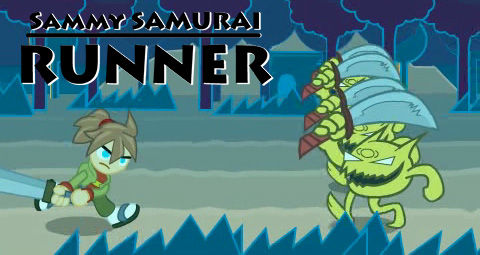
Sammy Samurai: Runner
Play it at www.sammysamurai.com

In late November of 2008 I found a forum post on Flashkit that linked to a contest from Mochiads. I wasn’t too excited about the prizes, the runner-up prizes were almost a joke, but I saw this as an opportunity to rush and actually finish something. Winning would be a plus. I hadn’t released a Sokay game in 2008 so I felt it was my last chance.

So I wanted to plan something that I would be able to finish within a month. That meant it had to be a lot simpler than my usual grandiose visions. I passed up on the opportunity to work with the Donut game I’ve been working on because there was a lot of animation that needed to done that I didn’t want to think about.

I had recently been inspired by the Studio Ghibli film Tales from Earthsea. I didn’t think the movie was very good but it has some awesome background design and a few shots had some excellent parallax scrolling going on. The parallax shots were very quick but captured my attention. Thanks to digital compositing they were able to blend many layers without making it obvious where one layer ended and another began. Continue Reading…

Sokay Blue
New Sokay.net, check it out!

I just finished the new Sokay.net layout for 2009. It’s all Flash now. I’m using swfAddress for deeplinking into the Flash content. Very nifty. I’m also using my favorite Flash utility tweener for the transitions. I’ve been working on this on and off for the past month. I wanted it to coincide with a widespread release for our latest game, Sammy Samurai.

I’ve also made the previous versions of Sokay.net available.

Sokay.net circa 2004

Sokay.net circa 2007

I think it’s funny how close the 2004 one is to the current one.

Now that that is done with, time to work on more games!


Friendly Integration: click here to play

I’m releasing the source code for a Papervision3D game I was putting together. This project was meant to be an interactive visual for a party my friend threw last weekend, Friendly Integration. This game was meant to be projected onto a wall and controlled with a DDR pad for each player. There were also plans to have additional panels that could be stepped on that changed the “theme” of the game.

Continue Reading…

Looking through my old artwork, I found these files…

I made these a little over 5 years ago. These are based on a drawing I made — and more like it . The Flash movie was a demo of how I could execute a game cinematic. The Papervision stuff I’m doing right now is looking awfully similar. I started developing a game based on these concepts but I went in a very different direction. It’s one of the projects I’m going to get back to one of the days.

Back then I was still in art school. Basically my free time was spent drawing and working on Thugjacker. I lurked Pixelation all the time. It’s a forum for pixel artists, if you haven’t heard of it. Lots of inspiring work there, a great place to get critiques. Pixel Joint is another good pixel spot.

Here are some NPCs from the Sokay Donut game I’ve been working on for forever. These characters are designed by our character designer Ricky Enriquez. I spent a couple days converting the game to AS3 in late May. Since then I’ve been polishing some things and working on getting the NPCs in it. I’ve been concentrating a bit too much on the presentation of the game and have returned to focusing on the gameplay, since it’s still not fully there yet. Right now I’m working on finding the fun, but it’s looking great so far.

This is a background concept I sketched out for a new project we started, a game that Chris is programming. It’s a Western so it’s gonna be a lotta fun.

Beyond this stuff I’ve been reworking the blog — I added the little video jukebox in the top right corner. I’m revising some of the other Sokay sites, experimenting with new ideas. I’m working with David Rodriguez on a more elaborate Luvtank.com as well.

Read on to see what’s been inspring me lately…

Continue Reading…

Long, long ago, I posted about my old TraceManager class for supreme debugging, but it was flawed! Hans from ObjectPainters was kind enough to comment with a link to a similar project he had put together. His did not have as much sophistication in its data tracing, but it did have a “FunctionWrapper.” His FuncitonWrapper could modify existing functions in run-time (so you don’t have to) allowing his tracing capabilities to be applied to any function without requiring the programmer to modify actual class files.

Hans was right about the usefulness of a function wrapper, but I didn’t feel like getting into it . . . until now. A couple days ago I brought up my old TraceManager and decided it was time to revamp it.

//Wrap class
traceManager.wrapClass(testClass , “testClass”)
//Run class function
var diff:Number = testClass.Subtract(6 , 3 , “trace:Infinity”)

The testClass.Subtract() function above was not capable of producing sophisticated trace data until the traceManager.wrapClass modified it and every other function in the testClass class.

I’ve taken Hans’ proposal one step further, by creating a ClassWrapper (using the undocumented ASSetPropFlags) that will automatically apply tracing capabilities to all functions within a given class instance. Finally, I feel the TraceManager to be a tool that all actionscripters could use in any project:

TraceManager.zip

I’ve added those 2 new functions, modified formatting a bit, and made a few other slight adjustments. If you used the previous version you probably will barely notice the differences outside of the 2 new wrapper functions. For a review on the basic ideas check out the original post. Now I give you an example of a trace out and will explain use of the new wrappers. Continue Reading…

NorthStar is my new pathfinder for use with arbitrary, irregular polygons. CHECK IT OUT. Drag around the green and red circles. The green one is used as the start point and the red is the end

A couple months ago I decided I would begin working toward my long time dream of producing a real-time strategy game. I actually finished NorthStar and had this written a few weeks later, but I’m only posting now because I’ve been hard at work with the rest of the game! Now working on unit logic along with a new Sokay project (more on that later) and editing a new film (later still), so I been a little busy. Expect Demos.

I planned on basing the RTS engine on some of my previous work with physics (perhaps that sounds strange, but it makes sense). Step one was coming up with a pathfinder.

Continue Reading…

This is my first public Papervision demo. I’m experimenting with some techniques for the next Sokay game. This is also the debut of the main character for the game, designed by Ricky Enriquez. Check out the demo.


My Papervision Demo

This scene is composed of 4 planes — the cop, the sidewalk, the shop, and the city. I positioned them within the scene with code. The animation is handled with code as well. I’m using Tweener to move the cop left and right, as well as his jump animation. The camera is targeting the cop.

I’m going to keep playing with this. I want to push it further by adding some movement to the rest of the scene, perhaps tweaking the rotation of the buildings as the camera moves.

If you’re looking to start with Papervision, there are some excellent video tutorials at gotoandlearn.com that’ll help you get started.