“Behold! A Massive Overhaul!” – Bryson, the Mighty

Tonight I finished an update to our blog theme. The new theme follows Sokay.net’s color scheme and design more closely — it’s bothered me that they looked similar but different. I like the direction it’s going and I’ll continue to revise the design sporadically.

Indiecade’s this weekend! Although Chris and I didn’t get our entries accepted, it was disappointing that they didn’t even bother to give feedback on our games — they basically said “we got too many entries. if you’re lucky, you’ll get feedback”. I’m suspicious as to whether they even played all of the games submitted. When Chris submitted Children at Play to Indie Fund, he was given a prompt and usefull feedback from Jonathan Blow. And he didn’t even have to pay an entry fee, haha.

With the Donut Game, I’ve passed the Fight Game’s engine to David. He’s working on updating the Fight Game’s animation with his most recent updates. I’ve spent some time working on the UI and some effects for that section of the game.


(this is a work in progress, yo)

To help me ease my mind, I’ve been working on this pixel portrait between running around in circles. I’ve been getting some assistance from the Pixelation community, check out my Work in Progress thread.

That’s it for today!

Peace!

-Bryson

Donut Get: Car Segment
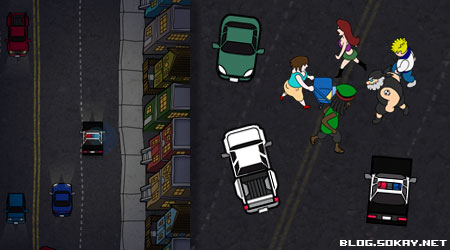
Artwork from the Car Segment of the game.

Work continues to progress on the Donut game. I’ve spent a great deal of the summer focusing on the Car Segment, which serves as an interactive intro. During this segment of the game, you play as the officer driving to the scene of the Great Donut Fire. You must drive through traffic, hopefully avoiding collisions with cars and civilians. The outcome of this section will be dependent on how you handle it — reckless driving will result in a ‘negative’ outcome where you don’t get to where you’re driving to.

Donut Get Fight Fight!With the Car Segment mostly wrapped up, I’ve moved on to focusing on the Fight Segment of the game, which acts as a mini-challenge within the game. David’s animating the characters for this part, the gameplay will be similar to Punch-Out!. I’m working on getting a skeleton of the game engine in place so that he can test his animation without requiring me to drop additional code in. Since this sections gameplay is so tied to the actual animation and timing, it’s important that he’s able to quickly iterate and test while animating.

The game is starting to emerge from the rubble and smoke. With every pass at detail and polish, it becomes clearer to see what the end result will be. While I chose to have the game mechanics relatively simple, I wanted to use them to play out a scenario and communicate ideas and themes from the world. This communication plays a larger role than it did in Thugjacker, where it was a bit more subtle, and is more integrated into the world than LUV Tank where it was much more blatant and abstract.

Most of the game artwork is done and in place at this point, but there’s a lot of animation that needs to be done. I’m doing planning for the game endings now, which will play a large role in the game. The way the game plays out will determine your ending — Way of the Samurai serves as my inspiration for this aspect. I’ve been thumbnailing these endings, working them out on paper while I develop the game.

Until next time…

Peace!

-Bryson

IGDA Los Angeles

The title of the talk was ‘Writing Games: Tall Tales of Triumph and Terror’ and it was held last Thursday at the Writers’ Guild of America, West headquarters in Los Angeles. It went alright, with some discussion of what it’s like to be a game writer, the new and growing position of game writers within the WGA (which allows game writers to join according to lower standards than film or television writers), and lots of nods to Uncharted 2 and Half-Life.

Everything pretty much went as I expected, but I found it very unfortunate that we did not see a discussion of the art or craft of game writing. We only really heard about the differences in work environment and technicalities. For example, it was generally agreed that game development involves far less clearly defined roles than filmmaking, so a writer can expect to play some role in game design and should expect the game designer to play a role in writing. A script writer should also expect his usual 125 page script to shoot up to around 800 pages for a game, since games are longer and a player may only experience a fraction of a game’s writing in a single play through. We did not, however, hear about anyone’s ideas on game writing, how a game is structured, approach, how they use the game to convey meaning or feelings. At one point it was mentioned that while in film it is said that a writer should ‘show’ and not ‘tell,’ in games a writer should ‘do’ and not ‘tell,’ but that was the extent of artistic discussion.

I stood up for the Q and A at the end and asked about the difference between games with mute protagonists and those with talkative protagonists, citing Half-Life and Uncharted and asking how each writer felt about the different approaches to game writing. This, I thought, was a question they could bite into. Surely one of these guys struggled at one time or another with the contradiction of a game’s protagonist being both a unique character and being played by the player, or at the very least, thought it was interesting, thought something could be done with that. Right? One of the writers reiterated that Uncharted 2 and Half-Life were both great games and simply said sometimes you go the one direction with a mute, and other times you go with the yapper. Nobody else had anything to say. So that was my shot. Oh well.

Anyway, I had a good time, especially talking to some of the writers over cokes. I even met a flash developer by the name of Tamar Curry. Seemed like a cool dude.

This is my second IGDA meeting and I recommend checking them out, especially if you want to meet some local LA game developers. Students and indie devs show up in addition to folks from some of the larger companies, so it’s a good bunch.

-Christopher J. Rock

Bryson’s been pressuring me to post about Children at Play for a long time, and I kept telling him “I’m too busy working on the game!” But enough a’ that crap. I uploaded the video preview to YouTube and I’ll have a playable demo up here very soon.

I started work on Children at Play at the start of last winter and its eaten a lot of my time since then. I consider it a small step, but an important one, in the right direction. I’ll save any in depth discussion for when I’ve got the demo up. For now I’ll post some text I’ve put together for various submissions and whatnot.
Continue Reading…

Chris and I attended the IGDA LA Chapter’s July meeting for a panel discussion titled “Running a Small Development Studio: Perils, Pitfalls & Promise.I was interested in checking out the event because it was a relevant topic and I’ve yet to attend any of the LA Chapter meetings. I’ve been an IGDA member on 2 separate occasions but failed to see value in the membership since there were never any meetings. This year they’ve restarted and are having meetings the 2nd Thursday of every month.

The talk was excellent. The speakers gave a good idea of some of the challenges of getting a company started and keeping it rolling.

The speakers were:

John Beck CEO, WayForward Technologies (A Boy and His Blob, Where the Wild Things Are, Space Chimps)

Jenova Chen Creative Director, thatgamecompany (Flower, flOw, Cloud, Journey)

Tian Mu CEO, Co-Founder, Naked Sky Entertainment, Inc. (Star Trek DAC, RoboBlitz, RoboHordes)

Jesse Vigil Founder, Partner, Psychic Bunny (Codename Games, Lead Balloon)

After the talk, it transformed into a mixer. It was good chit-chatting with some of the homies and the regulars. Met and re-met a couple people we saw at the USC Global Game Jam. I had a good chat with the homies Nite and Deon, who worked on Lulu Cao’s thesis project, SomeDay.

This IGDA-LA event is every 2nd Thursday. It hasn’t been updated for a while, but you can try the website for info about the next one. If they keep having meetings of this caliber, I’ll have to renew my membership.

Oh yeah, baby. I came up. Won this wonderful game at the raffle.

Roger Ebert recently published an article reiterating his claim that games are not art. This was in response to a TED talk given by USC student Kellee Santiago.

I’d have liked to see Santiago take Ebert down a notch with a strong argument, but she came off as many of the ‘game school generation’ do: all talk and born to sell out (e.g. using marketability as evidence of artistry). I assume this is because graduates would rather not alienate the industry or general populace with their ideas, but the need to maintain a friendly facade dilutes the message too much for my taste. For that reason, I’d also have liked to see Ebert take Santiago down a notch, until he stopped making sense.

One of Ebert’s key failings is that his actual views on art remain a mystery and for that reason, I hope to convey my perspective through my discussion of Santiago and Ebert. I welcome attack.
Continue Reading…

Here’s a bit of artwork I drew for the Donut game’s intro animation. It’s roughly animated so my man Cryptic Circuity can lay down some tunes for it while I tend to other areas of the project. My current focus right now is the top-down driving portion of the game. I should be showing bits of that part soon.

Chris has been touring Europe for the past couple weeks so don’t think the war is over. He’s just been readying the quiet before the storm. I’ve managed to gain some ground on him without having to sabotage his project, but his game was just about ready for a demo release even before he left. Regardless, both of our games are looking top-notch and I look forward to revealing more.

Peace.


Some boards from the Donut game’s intro

I’ve been hustlin’ on the Donut game. In the past month I’ve been busting out on the collision for the car segment and the intro animation for the game.

I’ve been working with the other members of the team — Ricky, David and Cyptic Circuity — to organize our tasks. Ricky’s doing most of the game’s character art and animation, primarily the Car segment and the Donut segment. David’s doing animation for a Fight segment — he did LUV Tank’s in-game animation. Cryptic Circuitry is doing the sound, as he did with Sammy Samurai.

I’ve had an idea of what I’ve wanted for the intro for the game for a long time but I had been conflicted on how I could get the story across without it being too drawn out. As an introduction to the game, I didn’t want the intro animation overshadow the game itself. I also don’t want to devote too much time to it when I have a game to make! I want something that basically says “Here’s your character. Here’s your scenario. Now play!”

I think of my games as interactive animations so I’ll continue to explore this balance. I haven’t made an animation like this in a while but I’m having fun so I may grow accustomed to it.


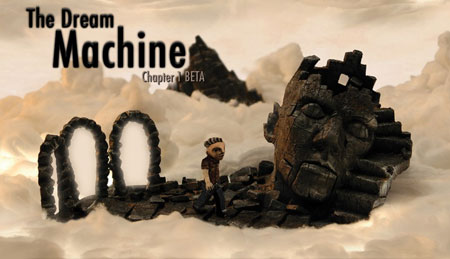
Play The Dream Machine at www.thedreammachine.se

I had contacted Anders Gustafsson, creator of Gateway II, and he gave me a preview of the first chapter of his latest game — The Dream Machine by Cockroach Inc.

I had played the demo before and while it was presented well, I didn’t know what to think of it. It was so short that it felt like it was over before it ever began. But after playing through the first chapter, I can now rest my worries. I can’t wait to play the rest!

First off the game is well written. While Gateway had some dialogue, its story was mostly told visually through the animation of the characters. In The Dream Machine, the characters have some great dialogue, which I find believable. The game start with your character, Victor, just moving into an apartment with his girlfriend. You get a good feel for their relationship through their talking. The game has dialogue branches which allow you to respond in a more serious or joking manner if you wish. It helped me to believe in the characters — okay, Game Creator, you’ve got my attention.

Continue Reading…


Some artwork I digitally painted for my Donut game

So I’ve been hard at work on this Sokay stuff but nothing much is ready to show yet. For the past month I’ve been cracking away at a new version of Sokay.net . It’s a bit of a subtle update, but I’m giving each game a profile page. I’m aiming to launch it with the release of Christopher J. Rock’s game, Rush Hour. He finished it a while ago and tried to find a sponsor but ended up starting work on a new game. He’s decided to release Rush Hour as a Sokay game, I’m proud to present it. You can read about it in Chris’ post about it.

I’ve been heavy in the art and interface of the Donut game, on and off for the past few months. I’ve finished most of the menu interface. I’m glad that’s together. Next I’m going to finish up the introduction game. The Donut game is essentially 3 mini-games tied together through a scenario. So far I have 2 of the 3 engines in prototype forms, practically alpha. A lot of the final artwork is in, but the gameplay’s missing a lot of features. I develop games heavily with the artwork in mind, so I tend to do more of the artwork upfront, which is the reverse of what many developers would recommend. I think they’re probably just more programmer oriented, rather than visually.


Here’s a sketch I drew for the game. Most of the art starts off like this.

So we continue, one step at a time. I look forward to showing ya’ll another game. It’s what I live for.

Peace.